Showing posts with label Freedom of Press. Show all posts

Monday, February 29, 2016

Can Dundar: A Journalist's Struggle to Defy the Odds

Last Friday, after 92 days of being imprisoned, the Editor-in-Chief of the Turkish opposition daily Cumhuriyet, Can Dundar, and his colleague, journalist Erdem Gul, were released pending trial.  This came upon a surprise decision by Turkey's Constitutional Court's ruling that their rights had been breached. The two journalists were jailed 5 months after the newspaper released a story on a secret Turkish arms transfer to Syria. If found guilty the two could face life imprisonment.  


In January 2014 the story first made headlines as Turkish prosecutors demanded the seizure of the secret arm shipment, which the Turkish government had claimed was humanitarian goods. All state authorities who took part in the raid were later jailed or purged from their work accused of numerous crimes related to espionage and staging a coup against the government.

Can Dundar-This picture originally appeared in Todays Zaman 
What makes this current story unique is that for over a year, Can Dundar has been in a public scuffle with the Turkish president, Recep Tayyip Erdogan. It is important to keep in mind that Dundar is also not just your average journalist. He is a very popular writer and a documentary film maker. He is sharp, witty and has a laid-back yet hard working character. In short, his boldness has proven to be the perfect match for Erdogan with the two constantly butting heads.  


In fact, it was Erdogan who opened the criminal investigation against him, demanding a life sentence, stating that Dundar would pay the "highest price" for his actions. Already late in 2014, a case had been opened against Dundar for defaming Erdogan and his son, Bilal. Last December, however, while imprisoned for the Syrian arms transfer story, he was found innocent on the charge of defamation, much to the dismay of the president.

As people gathered last Friday evening at the Silivri prison gates awaiting their release, they ended up having to wait until 3:00 am, thus coinciding with Erdogan's birthday. Dundar seized this opportunity to take a jab at the Turkish president, cynically stating that he was sorry that his friends had to wait so long but his February 26th release was well-timed as a birthday present for Erdogan. 

Well, Erdogan has taken their public quarrel to a new level all together. On Sunday he stated the following shocking words, "I will remain silent to the decision the court has given. But I don't need to accept it, I want to make that clear. I don't obey or respect the decision…this has nothing to do with press freedom. This is a case of spying." 

In other words, the spat between the two now has the Turkish president openly defying the Constitutional Court. 

Dundar seems poised to continue on with his struggle, now addressing Erdogan in an open letter, where he thanks him for sending him to prison, explaining how the prison has made him a better person and writer, in addition to showing the world the authoritarian shift taking place in Turkey. According to Cumhuriyet, the article has had a record 4 million hits

What is clear is that the stakes could not be higher and that this saga is far from over, not to mention the fact that according to the Committee to Protect Journalists, "Turkey remains the worst jailers of the worldwide," and that Dundar and Gul could once again find themselves behind bars for a very long time. For now, only time will tell....  

Sunday, February 8, 2015

The Turkish State against Frederike Geerdink*

Türkçe versiyonu için linke tıklayın

As Turkey continues to clamp down on journalists, the Turkish state has now targeted a foreign journalist on what appears to be trumped up terror charges. This week, an indictment was issued against Frederike Geerdink, a Dutch journalist, who has been based in Turkey since 2006, on charges of spreading propaganda via some of her writings, on behalf of the outlawed Kurdish Worker’s Party, the PKK, with her facing up to five years in prison. 

The indictment comes at a time of increased conflict in Turkey’s Southeastern Kurdish region, and the proliferation of state violence, which has steadily increased during the last six months. Therefore, the charges against Geerdink should be placed within the context of silencing journalists who write about Turkey’s decades-old Kurdish conflict, and not within the context of the recent attempts by the Turkish government to stomp out criticism of its president, Recep Tayyip Erdogan.

In fact, Geerdink’s thoughts appearing in both international and local news sources, such as the Independent and al-Monitor, or her popular blog, Kurdish Matters, in addition to her work appearing in the online Turkish newspaper Diken, must have sparked the government to take action, in order to put an end to her constant challenging it. However, it must be stressed that due to her status as a foreigner it made the headlines, while many stories go unnoticed, and a long list of Kurdish journalists jailed in the past. For example, just last week 12 students were sentenced to 20 years in prison on terror charges for singing Kurdish political songs on a university campus, while selling a pro-Kurdish paper.


All of this of course is occurring while the Turkish government is locked in a peace process together with the jailed PKK leader Abdullah Ocalan, in attempt to end the thirty years of violence that has led to approximately 40,000 dead. However, following the ISIS siege on the Kurdish-controlled Syrian city Kobani (Ayn al-Arab) last September (liberated just over a week ago), when Erdogan clarified that for him Kurdish YPG fighters, who have close ties with the PKK, were no better than the ISIS terrorists, tensions flared. For the Kurds, the comparison between the two groups made it clear that even if Turkey was not aiding ISIS, it was certainly set out on a campaign of demoralization against them.

Further, Turkey’s Kurds became increasingly frustrated at the double standard where in the recent past, jihadists set on joining ISIS have been documented numerous times crossing the Turkish-Syrian border unhindered, all the while teargas filled the lungs of those attending protests on the Kobani border, with the Turkish army blocking those trying to cross the border to join the battle against ISIS. In one of these protests, live ammunition was used, leading to the death of a young woman, Kader Ortakaya.   

The tension exploded however on October 6-7, when the protests turned violent with the supporters of the Islamist pro-government Kurdish Huda-Par clashing with the supporters of the mostly Kurdish HDP, who called protests in support of Kobani. While both sides blamed the other for the almost fifty people killed in street violence and targeted killings, including children, no state investigation has taken place, with it unclear what exactly the was the state’s role (including its void) in the unfolding of these events.     

If this was not enough, clashes continued in Turkey’s Southeastern city of Cizre between Turkish security forces and pro-PKK Kurds, which led to more deaths, proving to be a major test for the strained peace process; just last month, two minors were shot with live ammunition by the state security forces, killing 14-yr old Umit Kurt, and 12-yr old Nihat Kazanhan. In relation to the latter, Turkey’s Prime Minister, Ahmet Davutoglu, vehemently denied state involvement in the killing. However, a video emerged, which made its round on the Turkish nightly news, exhibiting otherwise.

It is this reality that Dutch journalist Frederike Geerdink is working and living in, as she is the only western journalist who resides in the Kurdish regions. And, while she is set on telling the harsh truth, writing in one of her blogs that “no, I am not scared. The state cannot shut me up, not even if they prosecute me, throw me in jail or throw me out of the country,” it seems the government has made a calculation that it is much more risky having her report, than the possible diplomatic fallout this will create.

Therefore, while there is no shortage of people ranging to beauty queens and high school students being placed on trial for their harsh criticism of Erdogan, the current case against Geerdink seems to be tied to the greater tradition of the Turkish state attempts at silencing the violent actions it is using against its own citizens in order to maintain hegemonic control of its Southeastern Kurdish regions.  

It seems safe to say that in this battle, Erdogan, and his AKP loyalists, could find new friends among even their greatest opponents, who see the Kurdish agenda as a tangible threat to the Turkish state. In other words, Geerdink’s sharp reporting and dedication at reporting what she sees and how she understands it, along with her Turkish counterparts, have a double hard time at doing their work, which is seen as both a threat to the ruling government and likewise to those among the opposition who believe that her reporting is nothing more than PKK propaganda. With the stakes so high, there is no doubt that Frederike Geerdink’s case could serve as a test for future international journalists in Turkey.  

 *This article appeared in Turkish, in the online newspaper Diken on February 6, 2015 (with possible revisions due to translation).  


Saturday, October 25, 2014

'Enemies within’: Journalists on the frontline in Erdogan's 'New’ Turkey* (Haaretz September, 23 2014)

Not even a month has passed since Prime Minister Recep Tayyip Erdogan was inaugurated as Turkey’s first elected president. During his campaign, he repeated the mantra that with his victory, a dawn of a ‘new’ Turkey would emerge. Unfortunately, for journalists who are critical of Turkish government policy, it is the same country it was exactly a month ago; a place where they are seen as the enemy from within, and are subject to threats, curses, and public shaming.

Just last week, a New York Times reporter, Ceylan Yeginsu, issued an in-depth investigative report on an Islamic State recruitment center in Turkey’s capital Ankara. The article was a fascinating read, which was based on Yenginsu’s entering “Hacibayram, a ramshackle neighborhood in the heart of Ankara’s tourist district,” which has “morphed into an ISIS recruitment hub over the past year.” In short, the article was a well-balanced look at how one-time drug addicts are attracted to join the ranks of Islamic State fighters in Syria.
My first thought after reading the article was that this was a brave piece of journalism. However, I also thought to myself that the author was just as brave for publishing the article, as clearly she was placing herself at risk of sparking an onslaught of hate and contempt among Turkey’s pro-Erdogan factions. Especially since just days before, Erdogan had complained to U.S. Secretary of State John Kerry, for what he described as a campaign against Turkey by the American media, in reference to a previous New York Times article about the illegal export to Turkey of oil coming from Islamic State-controlled territories.
It took no time at all after Yeginsu’s article was published that President Erdogan expressed his anger, especially outraged that the report had featured a photo taken of him and his newly appointed Prime Minister, Ahmet Davutoglu, leaving a mosque, which was in the same neighborhood, as if it was incriminating him personally with the content of the story. Importantly, as a reader, I never made that connection. Nevertheless, Erdogan described the article as “despicable, shameless, and vile,” which in turn led the New York Times admitting error andremoving the photo, and the journalist Yeginsu rightly stating in a tweet, “to all those that have targeted me personally, neither the photo nor the caption was my responsibility.”
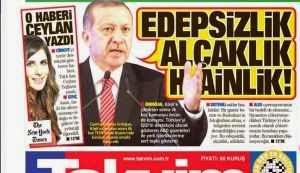
Despite the New York Times' correction, Yeginsu was bombarded by threats, and had her photo splashed across the front page of staunchly pro-government newspaper, Takvim, which highlighted that the author of the article was a “Turkish girl.” In other words, this was not an act of a foreigner being unfair to Turkey, but an act of betrayal committed by a Turk, one whom – no less – has been raised abroad and belonged to a distinguished family. In no time at all, the executive editor of the New York Times, Dean Banquet, published a statement condemning the campaign against Yeginsu, calling on Turkey to protect their staff in light of the high number of threats.
Unfortunately, the campaign against the NYT’s Yeginsu is not a lone incident. Following last year’s Gezi Park protests, Erdogan regularly blames the international media as leading an unjust campaign against Turkey, with journalists often targeted in public forums and on social media, which could be described as a well-oiled smear machine. If it is not Erdogan who is accusing them on stage, then it is his allies, often within the high echelons of the AKP, who set into motion this machine, beginning on Twitter, where many Turkish political debates are played out. Once out in the Twittersphere, AKP trolls seize opportune moments to attack anyone they deem as anti-government. This is often followed by the pro-government press jumping in, publishing names, personal details, and photographs, on their front pages and Internet sites.
A disproportionate number of Turkish women journalists working for foreign news agencies have been aggressively trolled in this way, not only those working for the NYT. During the Gezi protests, Melih Gocek, the mayor of Ankara and an Erdogan loyalist, started a twitter campaign against Selin Girit, a reporter for the BBC, whom he accused of being an “English agent.”
Last May, Erdogan targeted Rengin Arslan, who works for the same news agency, claiming that she had paid actors to portray themselves as mourning family members who expressed their opposition to the government. It seems Erdogan had been fed this false story by the pro-government media, who initiated the smear campaign against her.
And last August, a campaign was lodged against Amberin Zaman, a correspondent for the Economist and writer at Turkey’s Taraf, an opposition newspaper. In response to a remark she made in an interview, Erdogan referred to her as a “shameless militant disguised under the name of a journalist,” who should “know her place.” However, the intimidation is not reserved only for women working for the foreign press. Ceyda Karan, a critical voice within Turkey, also was taught a lesson about knowing her place, suffering a campaign against her during the past summer as well.
While the misogynistic undertones of attacking female journalists are clear, some male foreign correspondents have also been verbally attacked. The Turkish government’s targeting of journalists is becoming dangerously commonplace. Ivan Watson, a CNN correspondent was publically shamed by Erdogan, following his brief detainment by Turkish police while covering a story in Taksim Square, on the first anniversary of the Gezi Park protests. Der Spiegel removed their correspondent from Turkey, Hasnain Kazim, after receiving “hundreds of death threats” following his critical report of the above mentioned Soma Mine disaster.
Needless to say, the attack on journalists by President Erdogan and his close allies is just another sign of Turkey straying away from its democratic values towards a more authoritarian system. It adds to the already serious state of journalism in the country, where between 2011-2013, Turkey held the dismal world record for the most jailed journalists.
Furthermore, with much of the pro-government press, and the state’s Anadolu News Agency, serving as a mouthpiece of the government, it seems that Turkey will continue to work at taming the foreign press, regardless of the danger it might cause journalists or what it does to the reputation of the country. This is even more worrying since Turkey has a history of violence against journalists. In fact, over seven years ago, the Armenian Turkish journalist, Hrant Dink was assassinated; while the gunman was caught, the case still hasn’t established a verdict of who was behind it.
It is for this reason that like the recent case with Yeginsu, the threats against journalists must be taken seriously. For once and for all, Erdogan needs to put an end to the campaign and refuse both personally and through media outlets he influences to take part in such orchestrated attacks.
There is a fine line between promoting hate speech for political gains and that moment that someone decides to take matters in their own hands. If this is the “New Turkey,” I for one find it hard to find signs of hope for the future. For now, let us hope that with the daily news agenda changing, with the 49 Turkish hostages released by the Islamic State, Yeginsu will be able to get back to her own crucial work without the extra pressures of the Turkish government that sees her and other critical voices as enemies of the state.