Monday, February 24, 2014

The Major Contenders: The AKP and CHP (Turkey Local Election coverage 2014, 3)


Less than 5 weeks away, on March 30, the Turkey’s local elections will take place. There is no doubt that following the December 17 corruption probe the state of politics in Turkey has become precarious to say the least.

As the AKP government does its utmost to block the daily allegations of corruption emerging, it is passing new laws at record speed; one of these laws, is the recent Internet Law, that has been criticized both domestically and globally, as violating freedoms of internet users in the country. Despite all government efforts, Prime Minister Erdogan’s private conversations are being leaked daily, which appear to link him to corruption scandals and directly pressuring media to remove critical content.

Due to this atmosphere, the local election campaign had seemed almost if it had been postponed. However, this past week, we see that at last election time is here, and in full force! Despite the political earthquake however that has taken place in Turkey, for now it appears that the AKP will still come out on top, retaining its comfortable lead over the opposition CHP party. 


The 2009 Election Results: How much will this map change in the upcoming elections? To visit this interactive map see: to Al-Jazeera Turk's election coverage 

While Erdogan is calling this current round a “referendum” of his performance, we have to remember that he declared the same in the 2009 local elections; during that election his party actually lost popular vote (38%) compared to the 2007 national elections (46.47%). Well, despite the comparatively weak performance in 2009, in the 2011 national elections, the AKP hit its all time high, raking in 49.49% of the total vote. In other words, the local elections, even if serving as a possible indicator, cannot predict what will happen in national ones. Therefore, it should be clear that even if AKP drops, which it very well could, this does not necessarily spell long term problems for the party.

However, having said this, there are some developments in the Turkish political map that could serve as a sign of major change. First, the opposition CHP party has systematically consolidated power: in the national elections, it has grown from 19.38% in 2002 to 25.9% in the 2011 elections; in the last local elections it raked in 23% of the vote. If the party continues the trend of convincing the public that it is interested in becoming an inclusive party based on a liberalism, and not on its previous conservative secular tradition, it certainly could reach 30% in the 2015 national elections (not bad at all in a parliamentary system). In other words, while the AKP can afford to lose votes as incumbent party, it is crucial that the CHP will show marked improvement in the local elections in order to keep its electoral base energized and the momentum going.

The Million Dollar question of the upcoming local elections is if the CHP has a chance at taking the two largest municipalities, Istanbul and Ankara. First, while Ankara is important, if the CHP’s Istanbul candidate, Mustafa Sarigul, were to take the greater municipality it would send shock waves throughout the Turkish political system; Istanbul’s greater municipality has been under Muslim conservative parties since 1994, when the now Prime Minister of Turkey, Erdogan, swept it away from the CHP, as the representative of Necmettin Erbakan’s Refah Party.

There is no doubt that Sarigul has the experience (and charisma) to overtake the incumbent AKP mayor, Kadir Topbas, who lost respect in the eyes of many during the Gezi protests and following, having succumbed to the wishes of Erdogan, who often acts as if he is still the mayor of his home city. The question for Sarigul will be if this is enough to pass Topbas, who despite what I said still has major support among different sectors; in an upcoming blog I will address this more in detail. I will also look at CHP’s candidate Mansur Yavas, who also seems determined to his most to push out AKP incumbent Melih Gokcek, who also, despite what seems to be a decline in his support, still appears to have a strong power base.

In the next blog, I will address the current situation of the nationalist MHP party, and the mostly Kurdish/Leftist BDP and its sister party, the HDP. Of course, there will be more to come on the Istanbul and Ankara race. To be continued…..


FOLLOW ME on TWITTER @istanbultelaviv for more on whats happening in Turkey and Israel/Palestine, and the Middle East at large. Contact: louisfishman@gmail.com


Sunday, February 23, 2014

Erdogan attacks the Internet* (from Haaretz, February 11, 2014)

Protesters took to the streets in Istanbul last Saturday evening to voice their concerns over the new Internet law passed by the Turkish parliament just two days earlier. As is de rigeur in Turkey, the police dealt harshly with the protesters, firing teargas and water cannon, with skirmishes continuing well into the night. The government’s violent suppression of the protesters actually serves as an important metaphor for the way the Turkish government is using extreme means to silence any type of dissent, and as it does so, it is chiseling away at the state’s own democratic institutions.
The controversial Internet law has already been condemned both inside and outside of Turkey, including statements made by the European Union and the United States. The new law, once instituted, will allow the head of a government agency, the Telecommunications Directorate, to block websites at its own discretion, bypassing the currently needed court order. Furthermore, it will require Internet providers to store users’ browser information for two years and to forfeit it upon request, which is a clear invasion of user privacy. In essence, it resembles an extreme case of legalized state surveillance - an out-in-the-open Turkish NSA.
Despite the fact that Turkish Prime Minister Recep Tayyip Erdogan stated that the new law does not “…impose any censorship at all,” and will make surfing the net, “safer and freer,” the fears of Turkish Internet users are clearly not unfounded. According to a recent report by the Economic Policy Research Foundation of Turkey, Turkey ranks only second after China in blocking Internet sites. With around 40,000 sitescurrently blocked, the Committee to Protect Journalists has used the term “internet authoritarianism,” to describe the current state of affairs.
In other words, while we are speaking about the new Internet law, the public debate should really be on how to bring more freedom to an already censored internet that blocks such topics as Darwinism, Kurdish and political left news sites, and even gay-dating sites.
For many, the new Internet law is perceived as another attempt by Erdogan to usurp greater power, as he continues his battle against the Gulen movement, followers of the influential Turkish religious preacher Fethullah Gulen, who is in self-imposed exile in the United States. For Erdogan, the Gulen movement is a “parallel state,” which attempted to overthrow his government by masterminding last December’s graft investigation, uncovering massive corruption at the highest level of his government. Having a greater control over the Internet could be used against the Gulenists, the “illegal gang within the state,” but also against groups similar to the Gezi protesters, who were also accused of plotting a coup against the state.
Fears for the future of the Internet are also strengthened by the fact that not only does Turkey hold the world record for jailing journalists, but the Turkish government has stepped up its struggle against dissent in the press. Last Friday, the journalist Mahir Zeynalov was deported; an Azerbaijani national, who is married to a Turkish citizen, Zeynalov wrote for Todays Zaman, a newspaper affiliated with the Gulen movement. While his deportation is certainly related to his sharp criticism of the government, the official charge against him was “posting tweets against high-level state officials.” Erdogan recently opened a criminal court caseagainst Zeynalov alleging defamatory tweets.
If this was not enough, during the last few days numerous secret tapes have emerged revealing phone conversations between Erdogan and Fatih Sarac, an executive at Haberturk, a private television news agency. So far, four sets of recordings have been released, and in two of them the Turkish prime minister directly interferes in the content of news stories; the first conversation took place during the opening days of the Gezi protests, when Erdogan called Sarac from Morocco to demand the removal of a critical comment by an opposition leader in their newsfeed; in another, Erdogan complains to Sarac about a story criticizing state healthcare; three staff members were allegedly fired for submitting the story.
While the legal admissibility of these tapes is in question, there is no doubt they serve as yet as another troubling sign about the state of Turkey’s democracy. In most democratic systems, such blatant manipulation of the press would shake a government to its core, most likely leading to its leader’s resignation.
Ironically, it is in the emergence of the taped conversations, and other wire-taps of Prime Minister Erdogan and his family members, that we can find an analogy with the recent Internet law. There is no doubt that Erdogan is certainly right to be angered that he and his family have been secretly recorded. How much more so should ordinary Turkish users of the Internet be angered at being subjected to surveillance without recourse.
For now, the Turkish public is looking towards Turkey’s president, Abdullah Gul, hoping that he will veto the new internet bill and send it back to the parliament for reconsideration, together with a strong message to Erdogan that a red line has been crossed. There is no doubt that if he does so, it will be a brave move on his behalf. However, this too could be too little, too late; since the graft-investigation came to light last December, Gul has done little to stop Erdogan from continuing to monopolize power. In this context, the Internet law seems just like another piece of the puzzle in a greater question concerning the future of the rule of law in Turkey and the preservation of its democratic institutions.
*This article appeared originally in Haaretz on Feb 11, 2014; I am placing the entire text here since due to the paywall sometimes the link is blocked

Monday, January 20, 2014

Hrant Dink: Seven Years Marching for Justice (Buradayız Ahparig We are here!)

Hrant Dink (1954-2007): "As long as I live here, I will go on telling the truth, just as I always have." ."


For seven years now, on January 19, people have taken to the streets to remember Hrant Dink, who was shot dead in front of the offices of  Agos, the Turkish-Armenian newspaper, where he served as its chief editor. 

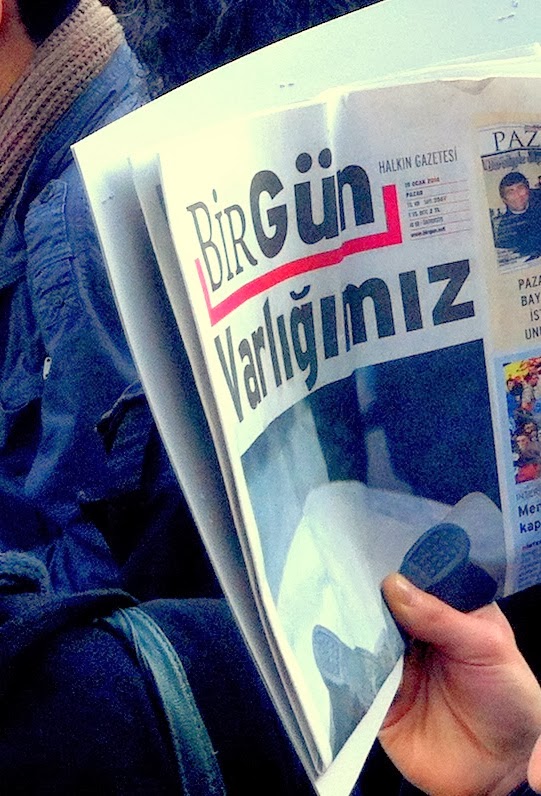
The newspaper, Birgun, opted to remember Dink by publishing the picture of when he was killed on that January 2007 day. All we could see from the covered body was the worn-out shoes with a hole in them-this became a sign of his modesty.


The annual march starts in Taksim and slowly makes it way to his offices in Osmanbey, a neighborhood in the Şişli district. With tensions high since the Gezi Park protests, three water cannons were placed at the starting point of the procession. Happily, all ended peacefully (just the night before police had used excessive force to silence a protest against internet censorship with teargas and rubber bullets). 


The marchers represent all walks of life: old and young; religious and secular; rich and poor; Turkish people of all religions and ethnicities:  Turks, Kurds, Sunnis and Alevis, Armenians, Greeks, Jews; also present were worker unions, and members of Turkey's LGBT community. Together everyone chanted "We are all Hrant, We are all Armenian."

A different chant heard over and over again was "Killer-State, we will hold you accountable!" For seven years, despite credible suspicion that some within the Turkish state apparatus (the Deep State) masterminded the assassination, the trial has been shrouded in cover-ups and only people on the lower-end of the ladder have been prosecuted. Even though the young gunman, and another shady character, have been convicted, the trial continues on...

Other chants included those remembering the seven young men who were killed in the Gezi Park protests, and get-well wishes to Berkin Elvan, the 15-year old, who during the summer protests, while out buying bread was hit in the head by a teargas canister-he is still in a coma. Lastly, a call to bring justice to Sevag Balıkçı was heard over the loudspeakers. He was an ethnic Armenian who was killed while serving in the Turkish army; despite the courts finding that this was a case of an accidental shooting, some of his army mates have a different story. He was killed three years ago in his barracks on April 24-the official day of commemoration of the Armenian Genocide.


Along the way, we passed a main road named Ergenekon, which leads up to the neighborhood Kurtuluş, home to many Armenians, and where Hrant Dink once lived. In addition to the name of the street's Turkish mythical nationalist significance, it also is the name of the ultra-nationalist group whose members were sentenced to prison due to attempts to stage a coup d'etat; many believe that some members of this group could have ties to the Dink assassination. Ever since he was killed, there have been calls to change the name of the street to "Hrant Dink" avenue. 


This was the last photograph as the marchers paused to let the merging group from "Hrant Dink" avenue join in, before making the way to the Agos headquarters. Among the people leading the procession is Rakel Dink, Hrant's wife, the one who has never stopped speaking up on his behalf, working endlessly to keep his memory alive.


Arriving to Agos, speeches took place and sad music was played. Among the speakers was Gulten Kaya, wife of the famous Turkish singer who died in exile, Ahmet Kaya. Also, one of the speakers stressed the importance that next year marks the 100th anniversary of the Armenian Genocide; in other words, it is impossible to separate the killing of Hrant from the massacre of Armenians in 1915. During the ceremony, some people cried, while others chanted defiantly. Slowly the tens-of-thousands of people holding signs in Turkish, Armenian, and Kurdish departed their ways. For seven years they have demanded justice, and until it is served they will be back. 


Buradayız Ahparig We are here!